Google Search Is Dying (For Your Business) — Unless You Do This One Thing in 2026
Google Search Is Dying (For Your Business) — Unless You Do This One Thing in 2026
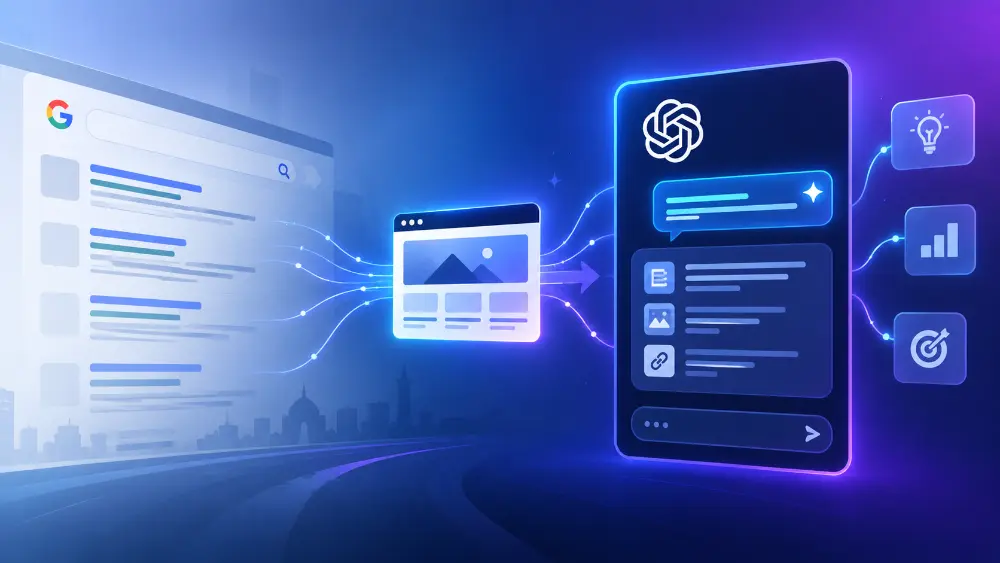
Try this now: open ChatGPT or Google and type "best web development company in Delhi NCR." Notice the result? The search does not give you ten links to click. Instead you receive one answer, written in a paragraph that names two or three web development companies in Delhi NCR. There is no scrolling no comparison shopping. The AI has already decided which web development company in Delhi NCR is best for you.
Now ask yourself the question: is your business listed among the web development companies, in Delhi NCR that the AI mentioned?
If the answer is no you face a problem that traditional SEO cannot solve because this is no longer search. Welcome to the era of Generative Engine Optimization (GEO) and Answer Engine Optimization (AEO). In 2026 ignoring GEO and AEO is not a mistake. It will determine whether your business is the choice or simply invisible.
Wait. Does SEO Already Do This?
I say no. This is the part that most business owners in India are getting wrong right now.
- SEO (Search Engine Optimization) places your website in a results page. That page is a list of links that a user must click through.
- AEO (Answer Engine Optimization) brings your exact answer right into Googles AI Overview box at the top of the page before any blue link shows up.
- GEO (Generative Engine Optimization) makes your brand appear by name inside ChatGPT, Gemini, Perplexity and Copilot when someone asks a question about your industry and no website visit is needed.
Here is the shift that should worry or maybe excite every business owner. AI tools do not get their answers from the sources that used to rank highest on Google’s search results. More and more the pages that Google ranks #1 and the sources that AI chatbots cite are two lists. If you have only optimized SEO, for the list you are targeting a shrinking audience.
Who Is Already Winning This Game.. Why It Matters to You
This is not a future trend. Every known SEO company in Delhi NCR is already changing service lines around it. Reports now mention brands showing up inside ChatGPT and Gemini answers not just Google page one. Local Indian brands, from D2C food businesses to real estate consultancies are already seeing AI-driven inquiries months before their competitors even knew what GEO meant.
The businesses winning now are not necessarily the ones with the largest ad budgets. They are the ones whose content is written in a way AI models can easily read take information from and trust enough to share.
That is good news for small and mid-sized Indian businesses. This is a special chance where being first and correct is more important, than being big.
So what actually makes AI engines mention your business?
It comes down to how these systems assess and reference content. Five things keep coming up as key:
- First being a defined entity online. That means your name, address and phone number. NAP. Must be consistent across your website Google Business Profile and other directories. This isn’t just good for SEO. It’s the foundation AI engines use to verify your identity. If the details don’t match they won’t trust your citation.
- Second, structured and extractable content. Think headings, direct answers to common questions FAQ sections and schema markup. This is where technical SEO matters a lot. AI models don’t read vibes. They pull sentences. If your site doesn’t have a quotable paragraph answering "how much does a website development company in India charge " the AI can’t use it. Even if it’s true.
- Third, topic authority, not keyword stuffing. AI engines prefer businesses that cover a subject in depth. For example a company that explains everything about hiring a web development agency in Delhi NCR. Including costs, timelines, team structure and client examples. Will rank higher than one that just repeats "web development company Delhi" over and over.
- Fourth third-party trust signals. Reviews, case studies with numbers and mentions on reputable websites. AI engines don’t take your word for it. They look for confirmation. If your business is talked about by sources, mentioned in media or backed by real client results the AI is more likely to cite you.
- Finally,. Specificity. Generic vague content doesn’t get picked up. AI favors answers with dates, real dollar amounts and real results. A post that says "we helped a client increase sales by 40%, in six months" is more likely to be quoted than one that says "we help businesses grow."
In short AI doesn’t care about hype. It cares about proof, structure and truth.
The Uncomfortable Part: Most Business Websites in India Aren't Built for This Yet
Here’s what we see across SME and mid-market websites in the Delhi NCR / Noida / Faridabad / Gurgaon belt: strong service pages, decent design, occasional blog posts. But almost none of it structured as direct citable answers. Blogs are written to sound professional, not to be quoted by a machine. FAQ sections are. Thin. Schema markup is an afterthought if it exists all.
That gap is the opportunity. The businesses that spend 2026 fixing this. Restructuring content around questions building topical authority and treating their Google Business Profile and reviews as seriously, as their homepage. Will be the names ChatGPT and Google AI Overviews reach for by 2027. Everyone else will keep fighting over a shrinking pool of blue-link clicks.
Where to Start (Without Overhauling Everything at Once)
- Look at the content you already have. Find the questions your customers really ask. Then answer each one in a short paragraph that stands on its own. No fluff. Just straight answers.
- Make sure your FAQ schema is added or updated on your important service pages. This helps search engines understand your site better and can boost visibility.
- Check all the places where your business information appears. That includes your website, Google Business Profile, online directories and social media accounts. Make sure everything matches. Name, address, phone number, hours. Consistency matters.
- Of creating many weak blog posts focus on building a few strong well-researched pages about your main topics. Use data. Cite sources. Show expertise. One solid page is worth than ten shallow ones.
- Keep an eye on how AI tools talk about you. Every weeks ask ChatGPT and Gemini the same questions your customers would ask. See if your brand shows up. If it doesn’t you might be missing an opportunity.
- Finally find a partner who gets both marketing and AI automation. A good digital marketing agency in India today has to think like an AI automation agency. They should handle content, ads and tech systems together. Not one piece, at a time.
The Bottom Line
Frequently Asked Questions
What is Google Search Is Dying — Unless You Do This One Thing in 2026 and why is it important in 2026?▼
Try this now: open ChatGPT or Google and type "best web development company in Delhi NCR." Notice the result? The search does not give you ten links to click. Instead you receive one answer, written in a paragraph that names two or three web development compan...
What are the main financial and operational benefits of Google Search Is Dying (For Your Bu?▼
Implementing modern engineering solutions reduces operational friction, improves conversion rates, minimizes manual maintenance, and delivers measurable ROI through scalable architecture.
How long does implementation take and what is the process?▼
Development timelines range from 2 to 6 weeks depending on custom feature requirements. The workflow follows discovery, UI/UX architecture, sprint development, QA testing, and live deployment.
How long before SEO optimizations show measurable organic rank improvements?▼
Technical audit fixes and site health improvements reflect in Google Search Console within 2 to 3 weeks. Competitive keyword ranking growth compounds over 3 to 6 months.